Friday, October 26, 2012

Discount Not the Dreamer

So Spake Mo
There is much to be said for the way the life of the child molds the mind of the man he will become. Once there was a little Russian boy whose joy was flying down hills in his toboggan…until he caught a cold, not a cold, but the deadly scarlet fever. He fought, he survived, but at age 10 he was left near deaf and school became such a struggle that he was ultimately turned out at age 14.


source: Wikimedia


From hence forward, books became his teachers.

And they drove him. At 16, they pushed him so obviously that his parents sent him to Moscow so that he might immerse himself in the Chertkovskaya Library, an Aladdin’s cave of intellectual wonders. As one of 18 children, the family could do little to support his explorations, but so caught up in his studies was he that a simple diet of black bread left him enough to fund his studies and experiments.

He had the time—and the space—to dream.


source: WikiMedia


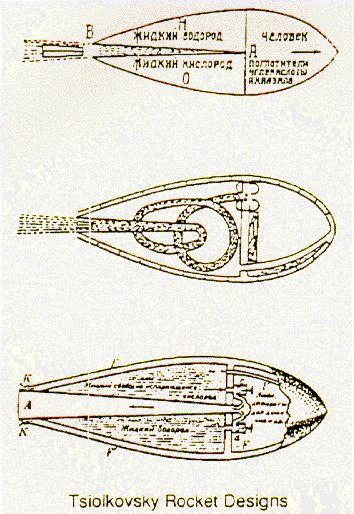
At first, he put his ideas to paper in the form of science fiction, more thought-experiment than character study. Quickly, his passion for rigorous study overtook him and he published his first scientific paper near the age of 23.  From there, the little boy from Kagula went on to create more than 400 works, dreams. Riding on the wings of another dreamer, Jules Verne, he was inspired compose 90 of those works on space travel, including rockets with steering thrusters, multistage boosters, space stations, airlocks for exiting and entering spaceships while in space, and closed-cycle bio-systems for food and oxygen in space colonies.


Tsiolkovsky's Spaceship
source: WikiMedia


While the rest of the world played with the precursor to the automobile, he was colonizing the stars.

With the inspiration of the Eiffel Tower, our dreamer roughed out the calculations for the geostationary altitude necessary to operate a “celestial castle,” an elevator operating within a tower that could deliver man to space. While his calculations also found the tower itself an impossibility, the idea remained…

…The Space Elevator.
 

source: (c) LiftPort Group


So Spake Me…
Konstantin Tsiolkovsky dreamed his dreams from 1857 to 1935. He is remembered as the Grandfather of Soviet Rocketry and the Father of Spaceflight, as the man whose work inspired those who finally did take us to the moon, including the father of America’s own space program, Wernher von Braun.
Like Descartes with the childhood illness that removed him from society’s prescribed daily routine and allowed his mind to roam far and wide (leading to analytic geometry and the foundations of modern philosophy), Tsiolkovsky’s willingness to seize this early intellectual freedom led him to explore ideas that had no obvious application at the time. Scientific dreams. Dreams that became physical science, that took on reality much sooner than he could possibly have imagined.


source: (c) AGeekMom


Were all 400 of his ideas the stuff of legend? Not necessarily. But in a time when humans were experimenting with awkward steam-powered cars, he was developing the sleek Tsiolkovsky rocket equation which rocket scientists still use today.


Tsiolkovsky Monumet
source: (c) Vladimir OKC


Dreaming matters. The dreams of Jules Verne who sparked Tsiolkovsky’s imagination. The dreams of Arthur C. Clarke whose further dreams of that space elevator would spark the curiosity of Jerome Pearson of NASA, who in parallel with Yuri Artsutanov of Russia, would pursue the idea into practical mainstream science.


source: WikiMedia


Then on to Bradley Edwards who secured NASA funding for the first serious feasibility study.

And from there the dream takes flight.


source: (c) Michael Laine


In 2006, Michael Laine assembles The LiftPort Group to develop the necessary technologies. The economy crash-lands the project for a period, but Laine’s group rises from the ashes with a successful 2012 Kickstarter campaign.


source: (c) LiftPort Group


And they are not alone. Tech giant Google joins the race in 2011 and the Obayashi Corporation of Japan joins in 2012 with claims of a completed project by 2040.

In SPECTRE OF INTENTION,
the date stamp on Kaitlin’s contract is May 13, 2048.

So here’s to a little Russian boy with his toboggan and a spark that has flown so far:

Discount not the dreamers, for they deliver us into tomorrow.


source: (c) LiftPort Group


“The space elevator will be built about 50 years after everyone stops laughing.”
- Arthur C. Clarke, 1985

“It’ll be built 10 years after everybody stops laughing…and I think they have stopped laughing.”
- Arthur C. Clarke, 2003, 2nd Annual Space Elevator Conference, New Mexico

 
References and Further Reading
The Space Elevator: “Thought Experiment,” or Key to the Universe (Arthur C. Clarke)
http://www.spaceref.com/news/viewnews.html?id=844

Wikipedia Space Elevator Entry
http://en.wikipedia.org/wiki/Space_elevator

Konstantin Tsiolkovsky
http://www.russianspaceweb.com/tsiolkovsky.html

LiftPort Group Kickstarter Campaign
http://www.kickstarter.com/projects/michaellaine/space-elevator-science-climb-to-the-sky-a-tethered

Konstantin’s Beanstalk—the Space Elevator
http://tappinginto.org/konstantins-space-elevator


Friday, September 28, 2012

On the Occasion of My Twentieth High School Reunion


So Spake Mo

Twenty years.

Twenty years since we shared the journey of childhood together, since the stories of our lives were so bound up in one another that we gave shape to each other, to the people we would become. Amidst canyon and sagebrush, in the cradle of a one-stoplight town, we began.


Twenty years.

Twenty years since we set off to become that something more, to create the new people we held in the dreams of our hearts. And in those twenty years, we created ourselves anew so many times: cashier, engineer, homemaker, soldier, admin, entrepreneur, artist, manager, teacher. Along this road, in the throes of the journey, we were aided by the wisdom and the folly of hundreds as we retooled our dreams to match reality…or reality to match our dreams.


Twenty years.

Twenty years into the journey we return. We come in the guise of middle age, wearing the dust of so long a road, so many selves created and discarded. We come wrapped in the critique and the support of the hundreds we’ve met along the way. But for all their love and advice, they could never truly know all of who we are. They were not there when we began:

Amidst canyon and sagebrush, in the cradle of a one-stoplight town.

Among those who helped shape our original story.

Among friends.

Welcome home.


So Spake Me…

There it is. My own personal creation story, my myth. And it is so very startling how archetypal the actors, events, the places of our legends become in just twenty short years. My memories have become aged snapshots, grainy and uncertain in their detail. Only the most vivid of the defining moments remain and as I gaze back at them in my mind, I can’t help but wonder how much of the truth remains after so many retellings.


I wrote Mo’s speech as the welcome piece for the reunion book, looking forward to the reunion, looking at those snapshot memories anew. With the fears of youth set to the side, curiosity rose up in its place. Slowly, steadily my classmates transformed into one hundred and thirty-four books I had never finished and “What happened next?” became the nagging question tugging at my mind every time I stumbled across a Facebook post, an old photo tucked in an worn children’s game, or a dusty yearbook I’d glanced past for years without seeing.


And when the nights came?

The stories were more fascinating than I could have possibly expected. Probably because they mattered to me. These people, I knew how hard they had to work, how far they had to climb to get where they were now. And the peaks they had conquered! Business owners, Air Force pilots, PhDs, researchers, mothers, fathers, husbands, wives, flying high in the big city, settling cozy in the small towns, even planting roots in our own hometown to keep her thriving.


So many stories. Each story so new and yet so familiar. So many glimpses at the archetype I had become in my classmates’ own legends—the girl I had once been seen from new eyes. Each glimpse so surprising and so sweet.


And when the nights were over?

I left with a bit of sorrow at the stories left unheard, at the renewed connections I knew would fade once more. I left missing my people.


But I also left happy. I am so proud of the people I come from, how they have grown no matter what path they chose.

 
When these images, too, become faded with age, the details blurred and uncertain, I hope I can still draw from my myth, from my memory, this timeless truth: I come from good people. Good people who are still out there in the world spinning their fascinating stories and sometime soon perhaps I will get to hear more.

And that brings me the profoundest comfort.

Welcome home.
 

Friday, August 31, 2012

The Shame of a Saint

So Spake Mo

Legend says that in the days before Bishop Honorius coaxed St. John Chrysostom from his solitude to bend his powerful oratory abilities to the service of the church, another came to visit the future saint in the cavern of his hermitage…a beautiful young woman fleeing the dangers of the wild.


At first this pious man turned her away, thinking her a deliberate temptation sent by the devil, a demon come to distract him from his pure purpose. However, the maiden managed to convince the saint that she was indeed a Christian, leaving him bound to offer her shelter.

Demon or supplicant, the result was the same.

The saint fell.

As the young woman grew greater and greater with child, the hermit could no longer face the evidence of his sins. In his despair, he tried to erase his crime. He threw the mother of his unborn son from a cliff.

Perhaps it was her screams, perhaps it was the sight of her body cracking against the rocks, but St. John immediately understood he had not erased his crime, merely increased it two-fold through this double murder. He stripped himself naked and threw himself to the ground vowing to live as an animal, not speaking, nor eating human food, nor looking up to the heavens until his sins were forgiven.

For months he went on like this, denying his humanity in penance for his sins until the day came that God chose to release him from this trial. In his savage state, St. John received again a visitor…a beautiful young mother suckling her infant child. It was through the mouth of the saint’s own innocent son that the Lord forgave St. John Chrysostom his sins and released him to return to his peaceful mediations.


In turn, the young woman was finally restored to her parents, the King and Queen, with much celebration.


So Spake Me…

In Alyse’s first day as a fugitive, she takes refuge in the Church of St. John the Golden-Mouthed, Venice’s relatively small chapel dedicated to this saint. She, too, is betrayed and turned out in violence. It would be so easy to pick up the feminist themes and rail against the objectification of women or to point out the unlikelihood of an unwed mother receiving a joyous welcome on her return to the palace in that era.

But what caught my eye in each of my sources for this tale (and there are many versions), what I adjusted in my own retelling, was the gloss applied to the double-homicide.

Violence in entertainment is always an argument-provoking topic. Gloss over it too much and you will find yourself accused glorifying the act, separating it from the consequences. Dig into it too graphically and you will be grouped with the artists contributing to the desensitization of society.

Violence whether emotional or physical is part of the human story. It is the thing we fear in the night; the undercurrent of our own rage. As much as I was repulsed by the light touch applied to the murder of a girl and her unborn child, as much as I turn away gore and spatter of the latest summer blockbuster, I would propose that the spectrum is necessary.

You cannot offer brutal honesty every time without numbing the masses, but sometimes…sometimes we need to be reminded that what we are accustomed to seeing has been sanitized, that the effects of a gunshot are devastating and not just to the body splattered across the bathroom wall, but also to the community to which that body was connected.

Sometimes we need to be reminded that the young woman dying of a pierced lung and a cracked skull at the bottom of the cliff will not get up again and birth a child to offer us forgiveness.

At least not without a miracle…


Tuesday, October 18, 2011

The Endless Cleverness of the Human Mind


So Spake Mo…
It is so closely our neighbor and the heritage of many a dear friend or co-worker and yet for all the grandeur of its landscape and culture, we fear it. The elegant architecture of old Europe, the ancient temples of early civilization lay shrouded from our view, withheld from inspiring our curious minds by a wall of violence and corruption.


Mexico. So near and yet so far.

A short while ago, my husband was nevertheless charged with traveling to Mexico City. There is always a thread of trepidation when a loved one goes so far away. This time it was no mere thread. Yet, it also proved to be one of the most fascinating and deeply moving explorations his business trips have afforded him so far.

Exploring a locale during a business trip is always a fast and furtive thing, but a connection need only take a moment. A brief stop at a cultural souvenir shop becomes a story, a glimpse into the magic of days gone by when humanity first began weaving a world of culture and technology around itself from…well in this case, an aloe plant more properly known as agave.

Set aside the image you have of the aloe plant that grew on you mother’s window sill with its tidy little pot and meet the version the ancient peoples of Central and South America knew. As tall as the man who is our guide and then again that wide, these plants produce a flower stalk as tall as a telephone pole. They are impressive, rather dangerous looking plants.


The man begins his story.

See here how much this one simple plant gave those ancient peoples, how clever they were to find uses for every part.


He slices off a leaf tip. With two neat snicks of his knife he trims the two corners off the base of the triangle. A couple scrapes of his thumbnail lift the filmy coating off each side of the leaf. He grips the film and strips the film away. It comes off as a sheet. A sheet of writing paper.


See here the paper the native people used for their records. Feel the texture almost like plastic. Here it curls as it dries, but opens once more when moistened.

Our guide pulls his knife carefully around the thick leaf just below its blackened tip. With a twist and a yank he pulls the needle free and with it comes the fibrous threads.


See here how each leaf provides the women with a needle already strung with thread. This black needle hardens as it dries to become a sharp awl. Or if the seamstress wishes to use a different tool, she can trim the fibers and use them as individual threads.


Now he draws us closer to peer into the heart of the plant where the flower stalk has been removed. Again he pulls out his knife and scrapes the sides of the hollow. The plant oozes forth its juices into the cup of its heart.


See here how the plant provides nourishment, this sweet agave nectar. And the nectar, we ferment for this milky-white beverage, pulque, whose sour tang offers sustaining energy.

How clever were the minds of the early peoples to discover these uses and so many more for just one plant. We marvel at the impossibilities of the pyramids and the palaces, the great roads and the aquaducts, but it is innovations of the everyman that make the story intimate, make us wonder, had we encountered this harsh plant in the desert, if we would have been so clever ourselves.


And so my husband walks into the shop to learn yet more stories of gold-flecked obsidian and of looms and of the shaping of silver into works of art, all tales he would never have heard of a creative and hard-working people hidden behind a veil of violence.

So much taken away from the world by a selfish few.

So Spake Me…
My husband met so many kind and generous people during his brief stay in Mexico City. With personal tours on their own time, associates showed him the wonders of their city with understandable pride. The photos he brought back were beautiful.

One associate claimed that Mexico simply had a bad marketing department. The violence occurred primarily to the north. Nothing ever happened in their part of Mexico City. This has a ring of logic to it. There are parts of L.A. I wouldn’t stroll with my children.

But if, within my small circle, I hear of one person’s co-worker being kidnapped at gunpoint and another person’s co-worker being carjacked by policemen, perhaps logic does not offer as much comfort as it should.

My aunt and uncle participated in an RV caravan through Mexico nearly a decade ago. They spoke of the beauty of the landscape dotted with more ancient ruins than one might realize, of startling poverty, of teenagers searching their RV with machine guns at the state borders. They said it was an amazing trip. They also said they wouldn’t do it again these days.

So will I experience that trepidation the next time my husband is sent to visit that client? Probably. But I will also know that the proper precautions can mitigate most of the danger. (After all did not one of my small circle get mugged in downtown Portland for not taking the proper precautions?) And I will wish for him another moving and fascinating whirlwind tour due to the generosity of his new Mexican friends.

And thank you to them for keeping my husband safe.

Friday, September 9, 2011

No Idea

So Spake Mo…
They had no idea what they were getting into.


Would an astronaut’s eyes work up in space or would the lack of gravity cause them to change shape, so that they could not see?

Would gravity affect his ability to breathe, even to swallow the food he needed to survive?

Could they keep a rocket together long enough to find out? They were replacing a warhead with a human payload on a freaking missile!

What would the surface of the moon be like?


One of the places the astronauts trained was the Craters of the Moon National Monument in Idaho. They learned to be the eyes and hands of the geologists back home, identifying volcanic rock and formations. But would the surface they reached be anything like that volcanic landscape?


In vastness and desolation, perhaps.

In volcanic formation, no.

Were the eyes a concern? No.

Breathing, eating? Not really.

Did they figure those human missiles out? Yes.

By the seats of their pants, by adapting the technology they were familiar with, by a vigorous outpouring of ingenuity and the determination not to be outdone.

They had no idea what they were getting into.

And yet they managed what man has dreamed since we first looked to the stars and thought to walk amongst those shining gods.

They had no idea what they were getting into, but they did it.

So Spake Me…
One of the reasons I’ve always found the story of humankind’s ascension into space so inspiring is the sheer impossibility of it. We should never have been able to make it happen. Where were the high speed computers, the advanced aeronautics, the streamlined and elegant technologies we so take for granted today?

But like so many other things in life, it is that overwhelming monument that cannot be conquered which finally inspires people to reach beyond themselves, to push each other past what they’ve always believed to be the limits of their bodies and minds. The highest mountain, the longest marathon, the greatest voyage.

So many of us stop with the I Don’t Knows. We look at that list of questions not as a checklist of activities to be undertaken on the path to Getting There, but as roadblocks, That Which Cannot Be Done. Problems which prevent us from even beginning.

When we begin, we never know what we are really getting into. Never. EVER. The simple trip from the family breakfast table to the front door: missing shoes, missing homework, dawdling kids, an emergency call from work.

Isn’t it a little strange that we expect any other undertaking in life to be any different?

They had no idea what they were getting into.

And neither will we, but it’ll be one hell of a ride.

**Astronaut photos courtesy of National Parks Service.

Tuesday, August 9, 2011

The Daredevil and the Fisherman

So Spake Mo… Once there was a man who—despite being on record as having broken nearly every bone in his entire body over the course of his illustrious career—managed to secure all the necessary permits from the city of Twin Falls, Idaho to stage a media extravaganza!


Before a crowd of spectators and media, Evel Knievel strapped into his X-1 Skycycle, preparing to make a leap of approximately 1,500 feet…over a 486 foot deep section of the Snake River Canyon.


He made it.

Sort of.

The rocket car’s parachute deployed prematurely, dragging Knievel back over the river, then further still to land on the launch-side riverbank. A few more feet to the north and he wouldn’t have walked away with minor injuries; he would have drowned. His parachute wasn’t the only thing to malfunction. His harness failed to release, trapping him in the Skycycle until help arrived.

Strip away the newsmen and the elaborate machinery.


Bring on the lower-budget daredevils: the fishermen. Approximately a quarter of a mile from the site of Knievel’s jump stands an abandoned platform overlooking those dizzying heights. Feel like dangling a line in the waters of the great Snake River? Grab your gear and your pole and join in your mind’s eye the fishermen of yesteryear as they shimmied down a ladder that hung from this platform in their quest to catch The Big One.

Funny, but the city of Twin Falls, Idaho decided to shut that one down…

So Spake Me…
For those of you unfamiliar with the man, Evel (formerly Evil) Knievel was the stuntman rockstar of his day. His Snake River Canyon jump has been called Woodstock with out the mud and rain.

Yes, hard to picture that in Twin Falls, Idaho.

My folks actually saw the jump. They were stopped on the Perrine Bridge that spans the canyon on their way to pick up some peaches. They watched him nearly land; they watched the wind sweep him back into the canyon.


And then there’s me.

Who snaps a picture of the fisherman’s platform as fast as she can and scurries away from the railing before the vertigo can pitch her head over heels into a picturesque death on the rocks…way…down…there.

PS—Did you know the Shoshone Falls (right next to these two historic sites) is taller than Niagra? Oh yeah, it’s WAY down there.

PPS—I, obviously, didn’t take the Knievel picture, having been less than a year old at the time, but I couldn’t find the name of the photographer who did. So, my apologies. On that note, the photo of the Perrine Bridge, a favorite haunt of base jumpers, was taken by my father.

Sunday, July 24, 2011

The Giant Rock Oyster Totem Tells a Tale…or Two

So Spake Mo…
Stories bend over time. They stretch and twist, they slide and expand to fit their new tellers, the new needs they are brought out to serve.


The Tlingit people of Alaska have assembled many of their people’s stories in the Saxman Totem Park outside of Ketchikan. Each totem tells a story. And when each totem falls, the story is written anew by the next generation’s carvers.


The foot of the Giant Rock Oyster Totem depicts the story from which the Giant Rock Oyster House of the Tlingit took its name.

A carver takes up his blade…

In a terrible tragedy, a young man of the house lost his life when his hand became trapped between the shells of a Giant Rock Oyster and he drowned in the incoming tide.

A new carver takes up the blade…


Once long ago, a boy wandered out in low tide and spied a pearl of great beauty in the glistening bowl of a great rock oyster. The exquisite pearl filled his heart with greed. Thinking himself clever, he sought to steal the pearl from the oyster’s maw. Snap! The oyster clamped it shell over the boy’s thieving hand and held him as the waters of the rising tide overtook him.

The carving blade passes to a new hand…

In a time not so different from today there lived a little boy who did not listen to his mother. Time after time she warned him against putting his hands where he could not see. And finally it happened: the boy reached into murky waters and disturbed the rest of a giant rock oyster. The boy shouted when the oyster clamped its powerful shells over his disobedient hand. His mother came and gave him his choices: he could either cut off his hand to free it from the oyster or he could try to hold his breath through the incoming tide. He chose to hold his breath and perished in the waves.

The story transforms with its tellers, its tellers transform with the telling. The story binds the listeners together through the generations, through the moment when they are reminded where they come from, who they are, who they were before.

So Spake Me…
We are losing stories.

We complain about lack of community. And yes, parents work more. Yes, technology creates a greater divide between people. But without a common core, without a common set of stories it is very difficult to create that sense of belonging that binds, that sense of belonging that drives people to set the report aside, to close out of the online games and step outside and join with their neighbors.

Shared experience creates stories that bind people. Just last night I stayed up until the wee hours reminiscing with a childhood friend I hadn’t seen in ten years. We laughed, we rolled our eyes and shook our heads and marveled at how the distance of decades and new experiences had changed the stories we shared. Old stories teaching new lessons over espresso and cheesecake.

We all love those tales of the glory days. We love to know there are people who know where we come from. Then imagine how even more powerful yet are those stories about our roots, weaving together far-flung families, drawing together even large and diverse communities.

So take a moment and learn the story of your family (I’ll bet its fascinating). Learn the story of your community and the brazen impudence that made it possible.

Then share it.

And see what you create.